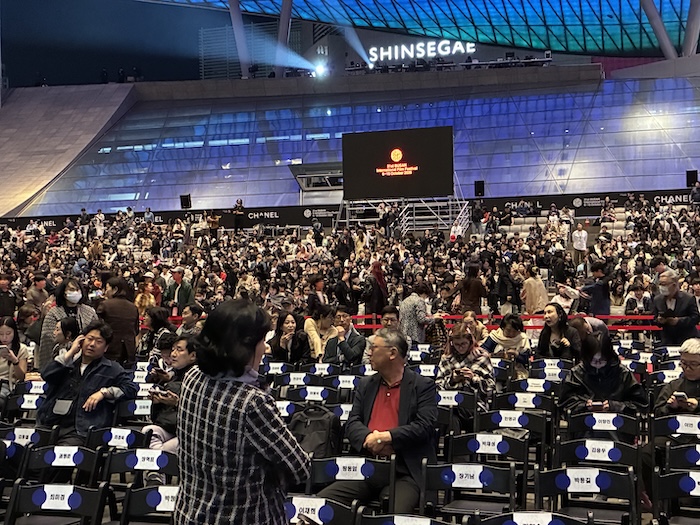
One of the older venues being used to screen films at the festival is the Busan Community Media Center, which looks as if it were built in the 1970s or 80s. I’ve already seen several movies there this year. Obviously when it was built Korean people were smaller, because the seats are cramped and there’s almost no leg room for someone who is over, say, 175 cm tall. They make an announcement before every screening, asking people to not move around so as not to bother the people around you, which is pretty difficult to do. I wonder because today’s young Korean men are noted for their height, or, at least, the movie stars and K-pop artists are.
I saw two LGBTQ movies from India yesterday. Both are produced by Neeraj Churi, who I am trying to get an interview with. The first one, Lovers in the Blue Night, is about a couple living in Mumbai who are Bangladeshi refugees. The husband works as a rat killer while the wife works in a bar mainly as a phone sex worker. It is slowly revealed that the couple, who are Muslim, have never had sex or much of any kind of intimate contact, though the wife never seems to suspect that her husband may be gay. He seems to know it, though, and when he serendipitously helps a thief elude the police, they become partners in crime and in bed. Though the social issues are obvious, especially with regard to women’s position in this particular kind of milieu, the movie is foremost a melodrama, and quite an effective one. All the characters exist at the bottom of the socioeconomic pyramid, and it’s implied that everyone has to lie, even to loved ones, just to get by.
The other Indian movie I saw was About an Intimate Matter, which deals mainly with the Indian public school system. As it turns out decorum is more valued than academic skills and student empathy, both of which are possessed in abundance by the main character, a female teacher at a high school in Kolkata who happens to live with a woman. When a student somehow gets into her private Facebook account and shares some photos with other students, the teacher is suspended pending an investigation, which is quite shocking in how deeply the school administration feels it can probe into her private life while giving lip service to the idea that one’s private life is off limits. It’s a canny film that shows how such matters tend to take precedence over what is supposed to be the priority—children’s education. In the post-screening Q&A the actor who played the teacher said that her love of teaching was more pronounced than her love for the woman she lived with, and that is the real tragedy. Churi, who said he has been out for 30 years, made the point that such couples should be deemed families, but that the social order does not permit them to call themselves that. But in any case, society’s prejudices go deeper than any legal concerns.
One of the biggest disappointments for me so far has been my inability to secure a ticket for any of the screenings of Possible Love. Lee Chang-dong is probably my favorite living director, but given the guest ticket system I couldn’t get one, so I’ll have to wait until November when it’s shown on Netflix. However, I did get to see the new movie by July Jung, who used to be Lee’s assistant director. I loved her first two films, A Girl at My Door and The Next Sohee, so I had big expectations for her new one, Dora, but, alas, it turned out to be another big disappointment. The title character is an 18-year-old girl with a skin condition that appears to be psychosomatic. She sullen and constantly apologizing for things that are not her fault and her parents, rather than pitying her, seem exhausted by the effort. They take her for the summer to their second home on the beach, which is next door to the father’s old acolyte/colleague (he’s a designer), who is married to a Japanese woman played by Sakura Ando. Lots of sexual shenanigans ensue among the various characters and Dora falls hopelessly in love with the Japanese woman, who is at first intrigued but eventually finds the girl’s neuroses off-putting. Much screaming and yelling ensued. The whole thing was just way too much and none of the characters felt at all plausible.
I finished the day with Hong Sangsoo, who is always reliable. His newest, Nowhere to Lay My Eyes, isn’t as good as the last movie I saw by him, What Does This Nature Say to You (there’s another movie that came out between these two but for some reason BIFF isn’t showing it), but it has its charms. Hong’s partner Kim Minhee plays the main character, a woman who makes experimental films for her own pleasure, a pastime her mother, a successful restauranteur who runs a pension on Jeju Island, can’t quite understand. The woman and her more passive brother visit the mother and her relatively new husband on Jeju and the tension underlying their polite conversations is so thick you could cut it with a chainsaw. Unlike in What Does This Nature, which has a similar plot, the other shoe doesn’t drop and mother and daughter don’t air their mutual grievances with force, but it gave me a nice buzz if only for Hong’s always unusual presentation, which in this case was represented by his comically harsh sound design and background music.